
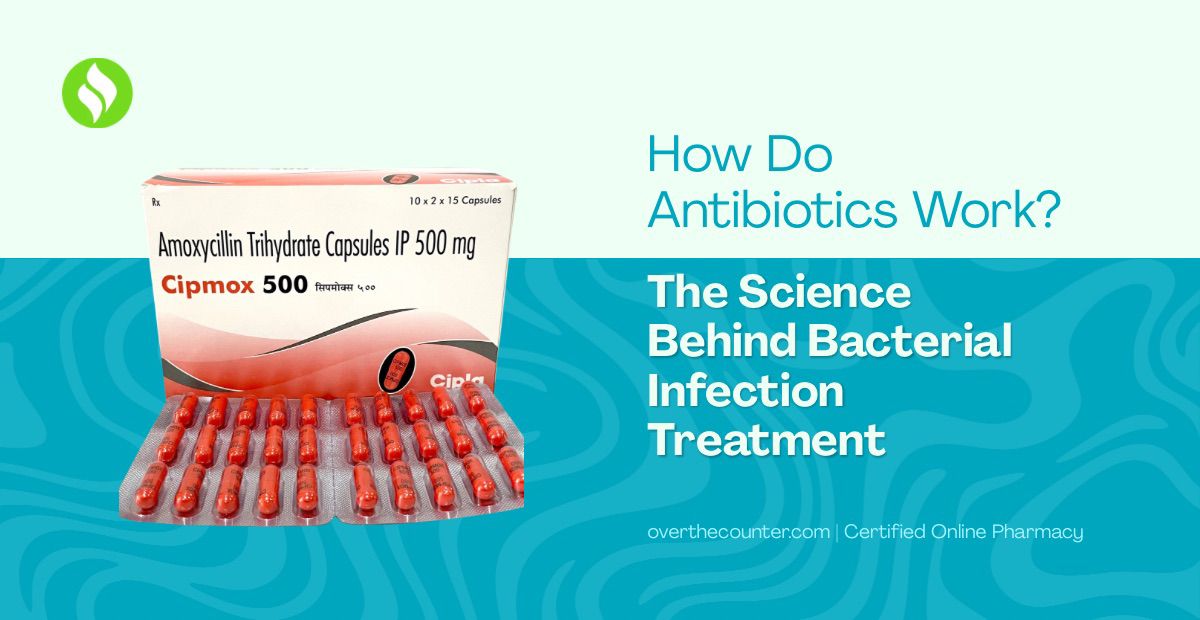
How Do Antibiotics Work? The Science Behind Bacterial Infection Treatment
Most people have taken an antibiotic at some point — for strep throat, a UTI, an ear infection, maybe a skin infection that wouldn't heal. You finish the course, the infection clears, and you move on. But the actual mechanism behind how antibiotics work in the body is something most people never learn, and understanding it matters more than you'd think. It affects how you take them, why you can't stop early, and why some antibiotics work for certain infections and not others.
Bacteria vs. Viruses: Why the Distinction Actually Matters
Before getting into how antibiotics kill bacteria, it's worth being clear about what they can't do.
Antibiotics have no effect on viruses. None. A cold, the flu, COVID-19, most sore throats — these are caused by viruses, and taking an antibiotic for them does nothing except expose you to side effects and contribute to antibiotic resistance. This isn't a technicality. It's one of the more consequential misunderstandings in everyday medicine.
Bacterial infections are caused by single-celled organisms that reproduce independently in the body. Viral infections are caused by particles that hijack your own cells to replicate. Antibiotics target bacterial biology specifically — cell walls, protein synthesis, DNA replication. Those mechanisms don't exist in viruses the same way, which is why the drugs don't transfer.
If you're not sure whether your infection is bacterial or viral, a doctor can usually tell from symptoms and sometimes a rapid test. For strep throat specifically, a throat swab confirms it in minutes.
How Antibiotics Kill Bacteria: The Main Mechanisms
Different classes of antibiotics work differently, but they all exploit weaknesses in bacterial biology that human cells don't share. That selectivity is what makes them useful — they can attack the infection without (ideally) destroying your own tissue.
Targeting the cell wall. Bacteria have a rigid outer wall that human cells don't have. Several antibiotic classes — including penicillins like Amoxicillin — work by interfering with the enzymes bacteria use to build and maintain that wall. Without an intact cell wall, bacteria can't hold their shape, fluid rushes in, and the cell bursts. It's not subtle, but it works.
Blocking protein synthesis. Bacteria need to produce proteins to function and reproduce. Some antibiotics bind to the bacterial ribosome — the cellular machinery that assembles proteins — and either slow it down or stop it entirely. The bacteria can't grow, can't repair themselves, and eventually die. Tetracyclines, macrolides, and aminoglycosides all work this way.
Disrupting DNA replication. Fluoroquinolones (like ciprofloxacin) target enzymes that bacteria need to copy and repair their DNA. Without functional DNA replication, the bacteria can't reproduce and begin to die off.
Interfering with metabolism. Sulfonamides block a metabolic pathway bacteria use to synthesize folic acid — a nutrient they need to survive. Human cells get folic acid from food and don't use this pathway, so the drug is selective.
The reason there are so many antibiotic classes isn't redundancy. Different bacteria have different structures and vulnerabilities. What works for a gram-positive infection like strep may not work for a gram-negative infection like certain UTIs. That's why a doctor's choice of antibiotic isn't arbitrary.
How Antibiotics Work Against Strep Throat and UTIs
These are two of the most common bacterial infections treated with antibiotics in the US, and they're worth looking at specifically.
Strep throat is caused by Streptococcus pyogenes, a gram-positive bacterium. Penicillin-class antibiotics — including Amoxicillin — are the standard first-line treatment because strep has remained largely susceptible to them. Amoxicillin disrupts strep's cell wall synthesis, clearing the infection typically within 24–48 hours of starting treatment, though symptoms may linger a day or two longer. Completing the full course (usually 10 days) matters because partially treated strep can lead to complications like rheumatic fever.
UTIs are most commonly caused by E. coli, a gram-negative bacterium. Treatment depends on local resistance patterns — what's first-line in one region may be less effective in another because antibiotic resistance varies geographically. Amoxicillin can treat some UTIs but is less reliable for E. coli than it once was due to resistance. A urine culture identifies the specific bacteria and its sensitivities, which is why doctors sometimes order one before choosing a drug.
The common thread: the right antibiotic for the right infection, confirmed where possible, completed fully.
Amoxicillin for Bacterial Infection Treatment: What It Covers
Amoxicillin is a broad-spectrum penicillin antibiotic, which means it covers a wide range of bacterial infections rather than targeting one type specifically. It's been in clinical use since the 1970s and remains one of the most prescribed antibiotics in the United States for good reason — it's effective, well-tolerated, and has a long safety record.
It covers strep throat, ear infections, sinus infections with a bacterial cause, certain pneumonias, skin infections, and some UTIs. It's also used as part of combination therapy for H. pylori, the bacterium linked to stomach ulcers.
It's available in multiple forms — tablets, capsules, and liquid — and is generally taken two to three times daily depending on the infection and dose. Most people tolerate it well; the most common side effects are gastrointestinal (nausea, diarrhea), which usually resolve on their own.
One important note: if you have a penicillin allergy, Amoxicillin isn't appropriate. This is something your prescribing doctor will ask about.
Why Finishing the Full Course Is Not Optional
This is probably the most frequently ignored piece of antibiotic advice, and the consequences are real.
When you start an antibiotic, it begins killing bacteria relatively quickly. Symptoms often improve within 48–72 hours. At that point, stopping feels logical — you feel better, why keep taking pills?
The problem is that "feeling better" and "infection cleared" aren't the same thing. The bacteria that survive the first few days of treatment are often the ones with slightly more resistance to the drug. Stop early, and those survivors repopulate. Now you have an infection that's harder to treat than the one you started with.
Completing the full prescribed course eliminates that resistant remainder. It also protects people around you by reducing the chance you're still infectious.
Infections, Immunity, and Related Health Conditions
One thing worth knowing: certain health conditions make bacterial infections more frequent and harder to clear.
People managing diabetes tend to get infections more often because elevated blood sugar impairs immune function — white blood cells don't respond as efficiently, and bacteria thrive in glucose-rich environments. If you're dealing with recurring infections and also managing blood sugar, the two aren't unrelated. Controlling blood sugar effectively reduces infection susceptibility over time.
Anxiety and chronic stress suppress immune function too, through elevated cortisol. This isn't a fringe claim — the psychoneuroimmunology research on stress and infection risk is well-established. People under prolonged stress get sick more often and recover more slowly. Managing anxiety isn't just a mental health issue; it's a physical health issue. Anxiety management options are worth exploring if stress feels like a constant rather than an occasional thing.
Weight and metabolic health connect to immune function as well. Excess adipose tissue produces inflammatory signals that can disrupt normal immune response. The connection between weight management and overall health runs deeper than most people realize — and infection susceptibility is part of that picture.
What This Actually Means for You
Antibiotics work by targeting specific biological structures and processes in bacteria — cell walls, protein synthesis, DNA replication — that either don't exist in human cells or work differently enough that the drugs don't damage us the same way. They're genuinely useful tools when used for the right infections, at the right dose, for the full duration.
The best antibiotic for bacterial infections in adults depends on the type of bacteria, the location of the infection, and local resistance patterns — which is why a doctor's evaluation matters before starting treatment. For a wide range of common bacterial infections in the USA, Amoxicillin remains one of the most reliable, well-studied options available.
If you think you have a bacterial infection, get it confirmed. Take what's prescribed. Finish the course.